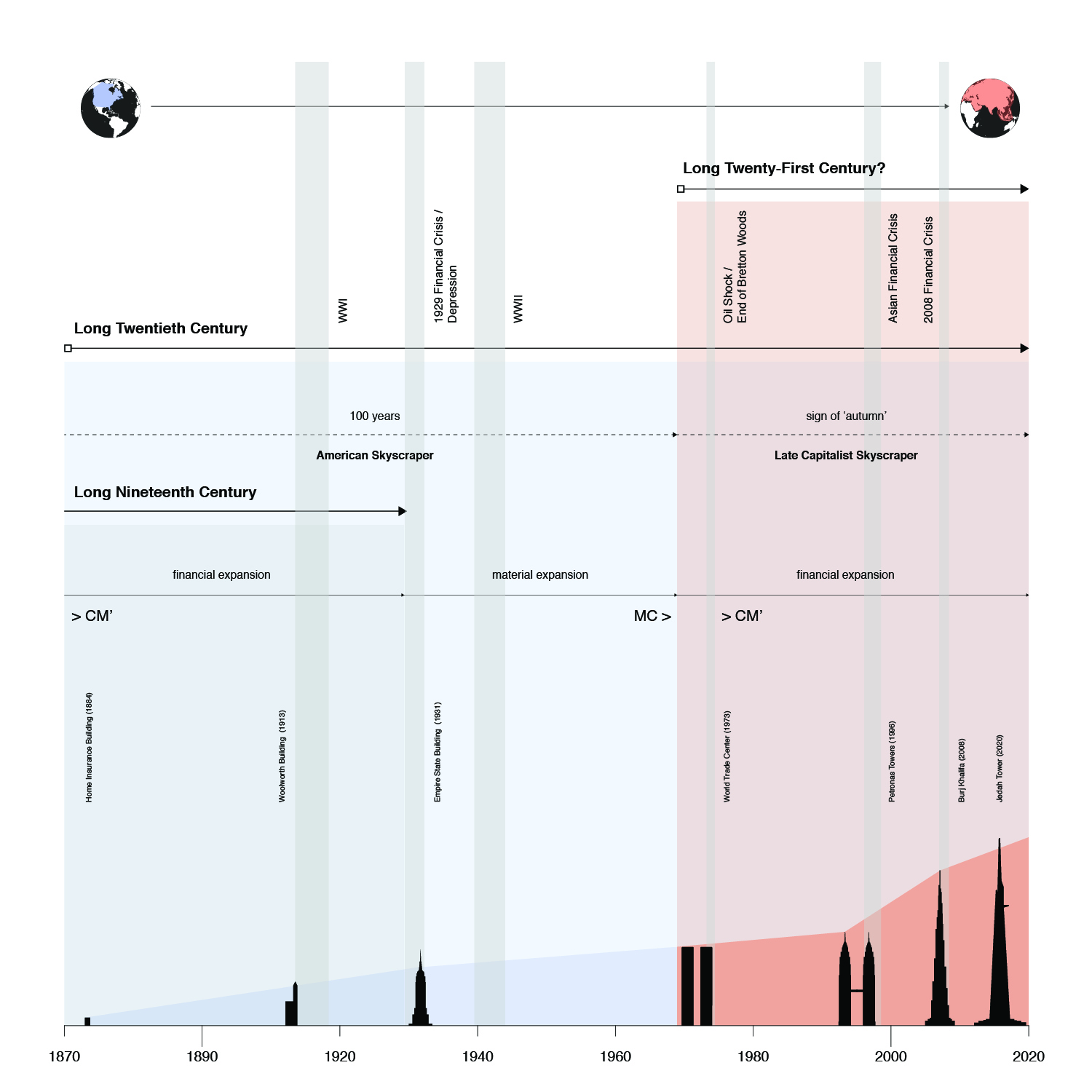
This dissertation argues that since the last quarter of the twentieth century—amid the rise of both planetary urbanization and global financialization—the skyscraper has become a privileged spatial instrument of late-capitalist accumulation: a form through which financial abstraction is rendered publicly legible across an unevenly developed urban world. Through a critical reconstruction of late twentieth- and early twenty-first-century urban and architectural theory, it tracks how the late-capitalist skyscraper’s recurrent “innovations” and conceptual mutations register a key movement in the organization of capital itself—especially the increasing entanglement of financial logics within urban development—and how, in turn, these rearticulations reshape the skyscraper’s symbolic economy, functional protocols, and territorial effects. As a multilayered narrative coupling theoretical critique with an archive of visual materials, The Late Capitalist Skyscraper maps the metamorphoses of this historically specific building type as symptomatic expressions of capitalist urbanization, treating the skyscraper as a diagnostic form through which the reconfiguration of capital–space relations becomes readable.
Outcome: DDes Thesis, Harvard GSD, 2019