Logistics Islands: The Global Supply Archipelago and the Topologics of Defense
Prism 3, no. 4 (2012): 54–75.
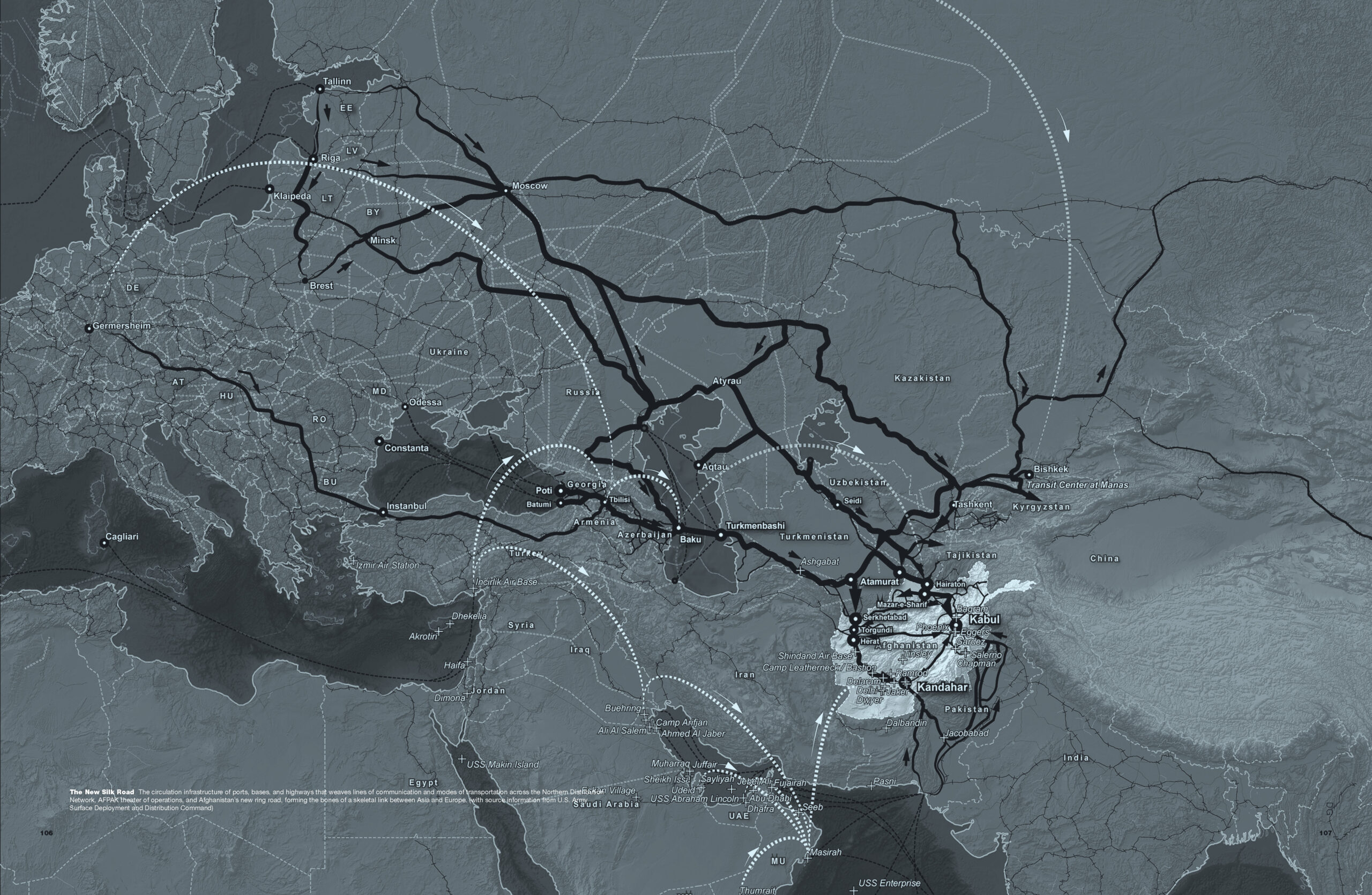
This article examines the spatial logic of contemporary military logistics through the concept of what we call the “logistics island,” a strategic formation that reorganizes global power projection through distributed infrastructures of supply, fuel, and mobility. Drawing on the case of U.S. operations in Afghanistan and the Indian and Pacific oceans, we analyze how logistical networks coordinated by institutions such as USTRANSCOM and the Defense Logistics Agency assemble a planetary archipelago of bases, pre-positioning fleets, and transportation corridors beyond the battlefield. These infrastructures operate across maritime, aerial, and terrestrial domains, linking sites such as Diego Garcia to continental theaters of war through a continuously adaptive system of sealift, airlift, and surface distribution. These logistical systems not only support active military operations but actively produce new geographies of infrastructure, urbanization, and resource circulation. By reframing islands not as fixed geographic sites but as nodes within a relational, topological network, the article argues that logistics has become a central geographic technique of spatial production in contemporary warfare and global economic circulation.