(Race) War Machine, or, How a War Game Explains the Paranoid Geographies of Transpacific American Empire
The Avery Review 53 (June 2021)
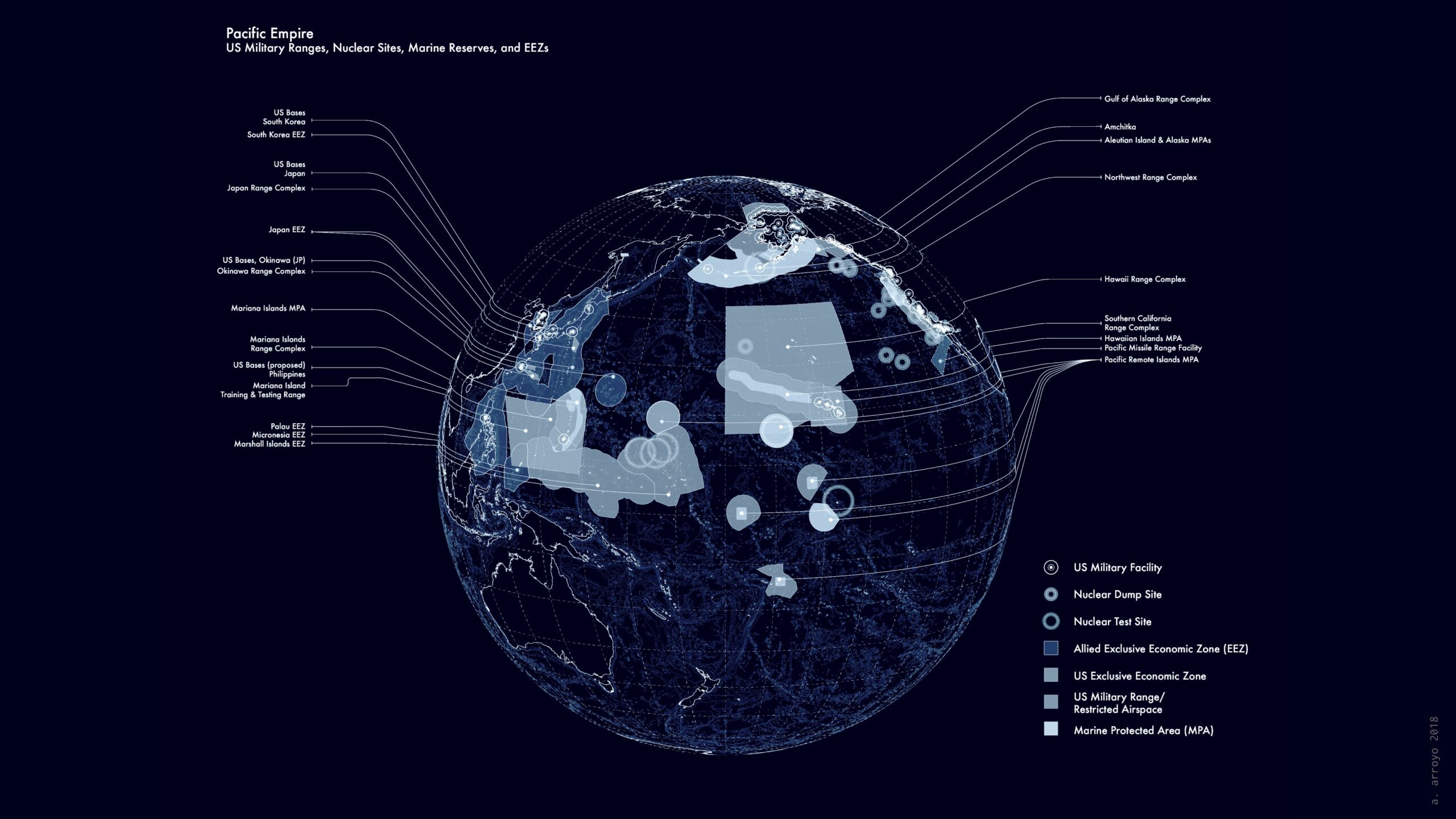
Between 1887 and 1941, officers at the Naval War College (NWC) in Newport, Rhode Island played out hundreds of “strategic naval war games” to simulate transpacific conflict with Japan. Eager to consolidate hegemony over the Pacific in the turbulent years following the Japanese victory over the Russian fleet at Tsushima (1905)— what historians have since shorthanded as “World War Zero”— planners at the NWC conceived this “problem of Asia” as one of world-historical consequence. In this frame, the multi-decade series of “chart maneuvers” and campaign simulations constituted a kind of computational geography for the algorithmic production of geopolitical futures. In this essay, I argue that “the Game”— both model of war and discrete simulations— can be read as what I call a “logistical image” of U.S. imperialism, in which the NWC sought to reverse-engineer the pathway to what a sympathetic interlocutor termed “white world-supremacy.” In so doing, I trace two spatial “algorithms” of racialization: first, a geopolitical racialization of Japan as a nation and imperial adversary; and second, a geoeconomic racialization of Indigenous populations across the Pacific, fragmented and recomposed into subalternity through militarized logistical networks. I follow how the computational geographies of the Game incubated a paranoid form of logistical reason, in which the specter of global race war became an incomputable horizon demanding infinite and indefinite preparation.